
Separate pokie claims from what the evidence shows
RTP can vary by venue, while available information may not confirm a machine’s setting or specific venue details.
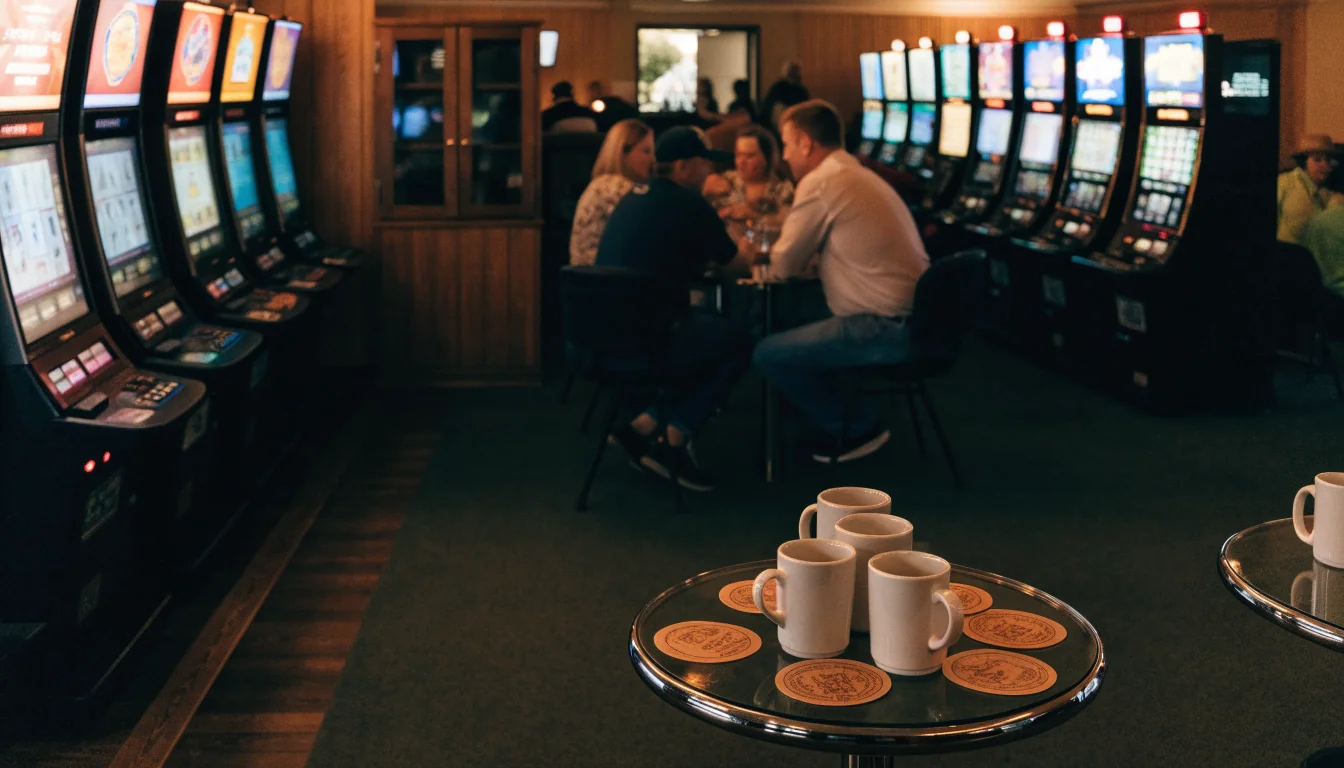
How Pokie Returns Can Vary Between Venues
A pokie’s name and appearance do not, by themselves, establish its return setting. A specialist review reports that some game providers allow casinos to choose between multiple return-to-player (RTP) configurations for the same game. If that option is used, an identical title may therefore have different theoretical return percentages in different venues. A comparison based on the game name alone can miss the setting that matters.
RTP describes a theoretical proportion of wagered money returned across a large volume of play. It is a feature of the game configuration, not a promise about what an individual session will return. A higher stated RTP can be useful for comparing like with like, but it does not mean that a particular machine will pay more during a particular visit. Nor does a game’s advertised return identify the setting installed at a specific venue unless that setting is also established.
That distinction matters when assessing claims about the best-paying pokies in South Australia. A title may be familiar across venues, while the return configuration attached to it may not be identical. Conversely, the same setting would not make the outcomes of two sessions match. The number printed in a description, where one is available, is a theoretical measure; it is not a forecast for a player, a machine or a venue.
Top Operators
Choosing pokies for South Australia means finding an online option that suits your preferences and checking its terms before you play. This list offers a concise starting point for your 2026 search.
-
Roby Casino
- License
- Curacao eGaming (Roby Games Ltd)
Roby Casino is listed with a Curacao eGaming licence held by Roby Games Ltd.
-
Uptown Pokies
- License
- Curacao (operating since 2017)
- Min. deposit
- A$20
Uptown Pokies has operated since 2017 and is listed with a Curacao licence. The stated minimum deposit is A$20.
-
GoldenCrown
- License
- Curacao Gaming Control Board OGL/2023/176/0095 (Hollycorn N.V.)
GoldenCrown is listed with a Curacao Gaming Control Board licence, OGL/2023/176/0095, held by Hollycorn N.V.
-
JustCasino
- License
- Curacao Gaming Control Board
JustCasino is listed with a Curacao Gaming Control Board licence.
-
Lucky Dreams
- License
- Curacao
- Min. deposit
- A$20 (POLi)
Lucky Dreams is listed with a Curacao licence. Its stated minimum deposit via POLi is A$20.
-
Golden Pokies
- License
- Curacao
Golden Pokies is listed with a Curacao licence.
-
Thor Casino
- License
- Curacao – Antillephone N.V. (Versus Odds B.V.)
- Min. deposit
- EUR 20
Thor Casino is listed with a Curacao licence from Antillephone N.V. (Versus Odds B.V.). Its stated minimum deposit is EUR 20.
-
Ricky Casino
- Payout speed
- crypto under 1 hour, PayID 1-3 business days
- Min. deposit
- A$20 (A$30 to qualify for the bonus)
Ricky Casino lists crypto payouts in under one hour and PayID payouts in 1–3 business days. The minimum deposit is A$20, or A$30 to qualify for the bonus.
-
Bizzo Casino
- License
- Curacao Gaming Control Board (TechSolutions Group N.V.)
Bizzo Casino is listed with a Curacao Gaming Control Board licence held by TechSolutions Group N.V.
-
Kingmaker
- Payout speed
- crypto ~90 minutes, fiat 1-5 days
- Min. deposit
- A$30
Kingmaker lists crypto payouts at around 90 minutes and fiat payouts in 1–5 days. Its stated minimum deposit is A$30.
Comparisons need to hold the relevant conditions steady. The game must be the same, and the RTP setting must be known rather than assumed from the title. Without both, a comparison between pokies in South Australia may put unlike configurations side by side or treat a general game specification as if it described every installation. A ranking that does not identify its basis can look precise while leaving the central comparison unresolved.
The distinction between return and outcome is fundamental. Each spin is generated by a random number generator, with its result separate from the result of the spin before it. A previous loss does not make a win due, and a recent win does not establish that another is likely. A run of results can look patterned to a person watching it, but that impression does not provide a reliable basis for predicting the next spin.
Independence also explains why a theoretical return cannot be checked by a short stretch of play. A small number of outcomes may fall well above or below the long-run figure without changing the stated configuration. The return measure describes aggregate behaviour over extensive play, not the result expected from a brief session. In practical terms, the mathematical description and the cash result at the end of a visit answer different questions.

A useful comparison therefore separates three things: the game title, the selected RTP setting and the random results produced during play. The title identifies the product. The setting describes its theoretical return profile. The results determine what happens on individual spins. Confusing these categories can make a venue comparison seem more certain than the available information warrants.
For South Australia casino pokies, a claim about a “best” game needs more than popularity or a familiar name. It needs a comparable basis: the relevant configuration and a clearly stated measure. If a return percentage is mentioned without showing which setting it refers to, it cannot settle whether the same title has the same return at another casino. If the configuration is comparable, it still cannot predict which machine will produce a better result during a particular session.
The same limits apply to comparisons involving CBD venues or online pokies. A location or delivery format does not change the distinction between a setting and an outcome. Nor does the word “best” resolve what is being measured: theoretical return, short-term results or a player’s preference are not interchangeable standards. A defensible return comparison needs a defined measure and comparable settings; random outcomes remain uncertain regardless.
The practical conclusion is narrow but important: the same pokie can be configured with different RTP settings, according to the specialist review, while no setting predicts the result of an individual spin. A game name is not enough to establish a venue’s return, and a theoretical percentage is not a personal payout forecast.
When Gaming Machines Are Operating: Venue Duties
A venue’s operating status and its obligations while pokies are running are separate questions. A machine being available does not, by itself, establish what support staff are on duty, what procedures are in place, or what hours the venue keeps. The clearest operational point in the reported rules is the link between machine operation and a responsible gambling officer (RGO).
A report by regionriverina.com.au says venues with more than 20 gaming machines must have a dedicated RGO on duty while those machines are operating, from 1 July. It also describes a one-month grace period for venues to introduce the officers and remove signage. These details should be read as a report of a specific requirement, not as proof that the same threshold or transition period applies to every venue in South Australia. Rules cannot safely be transferred between jurisdictions on the strength of a similar-sounding search.
The operating condition matters. The reported duty is tied to the period when the machines are running, rather than simply to a venue’s general opening status. A venue could be open for other activities without that fact establishing whether its pokies are operating. Conversely, a venue’s advertised trading hours would not, on their own, confirm when a particular machine area is available. Those are distinct pieces of information.
The threshold is also specific: the reported RGO requirement applies to venues with more than 20 gaming machines. It should not be restated as a rule applying to every venue, nor does the report establish staffing arrangements at any named South Australian location. The requirement concerns a dedicated officer being on duty during machine operation; it is not a published schedule of which venues are open early, late or at a particular time.
The reported grace period concerns implementation, not a continuing exemption. It gives venues a month to make the changes described in the report. That timing does not establish the date on which a particular venue complied, and it should not be used to infer that a venue currently has or lacks an RGO. A current staffing claim would need venue-specific confirmation.

The same report describes a gambling incident register. The register is intended to capture details of incidents, including occasions when a patron’s behaviour indicates that they may be at risk of gambling harm or affected by it. This makes the duty more concrete than a general statement that a venue has responsible-gambling policies: an incident is to be recorded, not merely noticed and left undocumented.
A register is a record of occurrences, not evidence that harm has been prevented or that every incident will be apparent to other patrons. Nor does its existence reveal the contents of an individual entry. The operational value lies in preserving details for the venue’s handling of incidents, while the RGO requirement, where it applies, identifies a dedicated staff role during machine operation. Neither point identifies a particular venue’s performance.
Signage is another part of the reported transition. Separately, venue layouts must avoid signs directing patrons to gaming lounges when those signs are within eyeshot of ATMs or EFTPOS terminals, and signs directing patrons to ATMs when they are within eyesight of gaming machines. These restrictions concern where directions are displayed; they do not establish whether a venue is open or whether its machines are running.
For a person checking whether pokies are operating at a given moment, these duties therefore answer only part of the practical question. They describe staffing, record-keeping and signage requirements in the circumstances covered by the applicable rules. They do not confirm a live machine status, opening time, payout percentage or the arrangements at a particular South Australian venue. An operational safeguard should not be mistaken for a timetable.
The distinction is useful because “open” can mean the building is trading, a gaming area is accessible, or pokies are switched on. The reported RGO condition refers specifically to the last of those circumstances. It does not supply a clock time for when play begins or ends. Establishing a venue’s current operating status requires information about that venue, while understanding the RGO rule requires attention to its jurisdiction and machine threshold. One cannot substitute for the other.
Near the Airport: What This Guide Can Verify
A request for pokies near an airport is a request about geography, not a guarantee that a suitable venue is inside the terminal or close to it. “Near” needs a starting point and a destination: the relevant airport entrance, a named venue, and a route or distance connecting them. Without those details, a nearby label cannot support a practical comparison.

The same applies to searches for pokies near the South Australian airport, around the CBD, or in a central area. Those phrases describe different starting points and may refer to different parts of a city. A venue described as central may not be close to an airport; a venue near an airport may be outside the CBD. Treating the labels as interchangeable would turn a broad location request into an unsupported claim.
A useful location check would identify the venue by name and address, then establish how far it is from the relevant airport or CBD point. Travel time also depends on the route and transport method. A map result or a place name alone does not establish that a venue has pokies, that it is open, or that it is the closest option. Each claim requires its own confirmation.
Some searches mix South Australia with terms such as “Vic”, “north”, “central” or “Parkes”. These may reflect uncertainty about a place name, a broader regional search, or a request associated with a different location. They do not establish that the named area is in South Australia, or that a particular venue there offers pokies. A result should not be treated as a South Australian recommendation merely because South Australia appears in the search.

“Near me” is even more dependent on context. It refers to the location of the person searching, which can change from one search to another. Without a confirmed starting point and a confirmed venue address, there is no meaningful way to state which premises are nearby or how close they are. A distance that is accurate from one point may be irrelevant from another.
The practical distinction is between search wording and location evidence. An airport or CBD term signals where someone wants to begin; it does not verify a destination. A venue listing needs to support the specific claim being made: that the named premises exist at the stated address and that the claimed proximity is measured from the intended point. General references to South Australia, a city centre or an airport cannot fill in those details.
That is narrower than claiming that no such venue exists. It means only that a recommendation cannot be made responsibly without a confirmed address and a relevant point of comparison. For searches combining South Australia with another place name, the location itself needs to be resolved before proximity can be assessed.

For a location decision, the useful unit is not “near the airport” in isolation. It is a specific venue, a specific origin, and a supported distance or route between them. Until those elements line up, proximity remains a description of the search, not a checked feature of a venue.
Online Pokies and Deposits: The Legal and Financial Limits
For anyone considering online pokies for real money from South Australia, the starting point is the Australian legal position, not the advertised deposit offer. The Interactive Gambling Act 2001 prohibits companies from providing real-money online casino games to people in Australia without a domestic licence. No Australian licences for online casinos have been issued, so there is no Australian-licensed online casino.
This is an operator-facing prohibition, not a statement that players are prosecuted for using an offshore site. But the practical risk is material: if an offshore casino refuses to pay winnings, Australian players have no legal recourse in Australia to compel payment. A deposit method or a polished bonus page does not change that position.
A bonus is a turnover condition
Promotional value depends on the amount that must be wagered before a withdrawal is allowed. A specialist review recommends treating wagering requirements of 35x or less as a more manageable benchmark and describes requirements above 40x as particularly burdensome. That is an assessment from a specialist review, not a legal standard or a guarantee that a bonus is worthwhile.
The arithmetic makes the condition clearer. If a $500 bonus carries a 40x wagering requirement, the required turnover is $20,000 before winnings tied to the bonus can be withdrawn. If the requirement applies to a $500 deposit plus a $500 bonus at 35x, the turnover becomes $35,000. These figures describe the stated terms; they do not predict a win or establish that the required betting will produce a withdrawable balance.
A free-spin offer can also restrict the amount of winnings eligible for cash-out. The maximum cash-out and the games or bets that count toward turnover need to be read alongside the headline offer. A large advertised bonus can therefore have a small usable value once its conditions are applied.
Bonus Turnover Calculation
-
1
Identify the requirements
Determine the bonus amount and the wagering multiplier (e.g., a $500 bonus with a 40x requirement).
-
2
Calculate total turnover
Multiply the bonus by the requirement ($500 × 40 = $20,000).
-
3
Assess the result
Understand that $20,000 must be wagered before any winnings tied to that bonus can be withdrawn.
Withdrawal conditions affect the final amount
The advertised balance is not necessarily the amount that can be withdrawn immediately. A specialist review reports that some casinos set weekly or monthly withdrawal caps between $5,000 and $10,000; under such a cap, a $50,000 jackpot could be paid in instalments over a prolonged period. These are reported terms at some casinos, not a market-wide rule.
Identity checks can add another condition before the first withdrawal. Have identity and address documents ready for verification; a casino may also request a selfie holding identification. The documents required and the review process depend on the operator, and an unresolved check can delay access to funds.
PayID is a bank-transfer mechanism, not evidence that an online casino is licensed, fair or transparent about its terms. Its presence cannot remove the legal and payment risks attached to an offshore service. For South Australian players, a deposit offer should therefore be assessed against the turnover calculation, withdrawal rules and verification requirements, while recognising that none of those conditions creates Australian legal protection for unpaid winnings.
Pokie Venues and Responsible-Gambling Measures
A South Australian venue cannot be judged on its pokies alone. Responsible-gambling measures affect the conditions under which play takes place, but a general description of those measures does not establish which safeguards a particular venue has in place. Venue-specific claims need to be checked against that venue’s own information.

Common tools include deposit limits, loss limits and session time limits. Each changes a different part of the spending calculation. A deposit limit restricts how much can be put into an account or play arrangement; a loss limit sets a ceiling on losses; a time limit constrains the duration of a session. Self-exclusion is different: it is an option to block access to gambling rather than a cap on spending or time.
These tools are not interchangeable, and a limit does not make a pokie predictable or guarantee a particular result. It sets a boundary around participation. For a comparison of venues, the useful question is whether the relevant measure is available and how it operates, not whether a venue uses broad language about responsible play.
The minimum legal age for gambling in Australia, including playing pokies online, is 18. That is a legal threshold, not a measure of whether gambling is affordable or suitable for an individual. Venue safeguards and age rules address different issues: one concerns access, while the other concerns managing participation.
BetStop is a self-exclusion register for Australian-licensed operators. It does not bind offshore sites. That distinction matters when discussing exclusions across different forms of gambling: a person who has excluded themselves through BetStop should not assume the restriction applies beyond the operators covered by the register.
For South Australian pokies venues, a useful account should separate general safeguards from confirmed venue-level details. The existence of standard tools does not establish that a named club or venue offers every one of them, nor does it support a ranking of the best venue. A meaningful comparison would require specific information about the measures available and their terms. Without that, describing one venue as safer or more responsible than another would go beyond what the general rules establish.
Do
- Use deposit, loss, and session time limits to set spending boundaries.
- Utilize self-exclusion to block access to gambling.
Don't
- Assume limits make a pokie predictable or guarantee results.
- Confuse a general responsible-gambling policy with confirmed venue-level safeguards.
Responsible-gambling measures are boundaries, not a forecast of winnings and not evidence that a venue is financially advantageous. Limits can constrain exposure; they cannot change the random nature of individual play. A venue assessment should therefore treat safeguards as one part of the operating conditions, separate from claims about game returns or location.
Opening Hours: No Verified 24-Hour Venue Details
A venue’s general opening hours do not necessarily establish when its pokies are available. The two schedules can differ: a premises may remain open while gaming areas are closed, or machines may operate only during specified periods. A claim about access therefore needs to identify the venue and the hours that apply specifically to its gaming area.
That leaves no sound basis for describing a local venue as open around the clock or stating that its pokies are operating now. An “open now” result is time-sensitive even when it refers to a verified business; it can become inaccurate as the venue’s hours change or a listing is updated late.
The distinction matters because “24-hour venue” can mean continuous access to the building, not continuous access to pokies. Listings may also combine restaurant, bar, accommodation and gaming hours under one label. Treating those hours as interchangeable turns a broad business-hours entry into a specific claim about machine access that it may not support.
A reliable hours check would need to match the venue’s current information to the relevant date and confirm that it covers gaming operations, not merely the premises. If those details are not stated, the practical answer remains unresolved: neither all-day access nor a particular opening time can be inferred.
There is also a difference between a venue being open and machines being available at the moment of arrival. A posted schedule may describe ordinary operations without accounting for temporary closures or changes. A time-specific statement should therefore be tied to current venue information, rather than inferred from a general listing or an old reference.

That standard applies to claims about South Australian pokies opening hours as much as to claims of 24-hour access. Without a venue-specific schedule for the machines, neither a statewide pattern nor a dependable “open now” answer follows. General opening hours are not a substitute for gaming hours, and a round-the-clock label should not be treated as proof that pokies remain available through every part of the day.
For anyone comparing possible visits, the useful distinction is simple: premises hours describe when the business is open; gaming hours describe when pokies can be used. Only the latter answers a question about machine access. Where the schedule does not separate them, the hours should be treated as unconfirmed rather than converted into a more precise claim.
Crown Casino Searches and the Limits of the Available Information
The Crown name in a search for South Australian pokies does not, by itself, establish that a Crown venue operates in the state or that Crown pokies are available there. A familiar casino brand and a local venue are different claims. Treating one as proof of the other can turn a broad brand search into an unsupported venue recommendation.

The same distinction applies to a “best pokies room” label. It implies that a particular room has been identified and assessed against others. Without substantiated details about South Australian venues, there is no sound basis for naming a Crown room, describing its machines or ranking it as the state’s best. A polished venue profile would not make those underlying facts more reliable.
Machine availability is also separate from venue identity. A casino’s name cannot establish which pokies it offers, whether a particular game is installed, or what return setting applies to it. Those details require information tied to the specific venue and machine; they cannot be inferred from a brand name or from general statements about pokies.
“Maximum cash payout” needs similar care. It can refer to different things: a machine’s stated prize, a venue’s payment procedure, or a limit on how much is handed over in cash at once. These are not interchangeable. A maximum prize does not automatically reveal the method or timing of payment, while a cash-handling limit would not establish the maximum prize available. No single figure can responsibly be attached to Crown pokies in South Australia without a relevant, current basis.

A useful comparison therefore separates four questions: whether the venue is in South Australia, whether it has a pokies room, what machines and settings are available, and how any payout is handled. A Crown reference may help identify the subject of interest, but it does not answer those operational questions. Nor does a general casino description establish that a particular pokie is currently on the floor.
For anyone comparing venues, the practical standard is evidence specific to the place and the point being compared. A venue listing can establish a location only if it names that location; a machine list can establish availability only if it relates to that venue; and payout terms need to describe the relevant payment arrangement. Without those distinctions, a claim about the best Crown pokies room or its maximum cash payout has no dependable basis for a South Australian comparison.
CBD Clubs: Venue Details That Could Not Be Confirmed
A club in a central business district is not automatically a pokie venue. The label describes an area or type of establishment; it does not establish that a particular club has pokies, where they are situated, or how many machines it operates. Those details need to be tied to an identifiable venue rather than inferred from the word “club” or from general information about gambling in Australia.
That distinction matters when comparing clubs in South Australia’s CBD areas. A ranking built on those assumptions would present a guess as a local recommendation.
The same limit applies to machine counts. A number attached to one venue cannot be transferred to another club, and a general rule about gambling does not reveal what is installed at a specific address. Even the presence of pokies at a club would not, by itself, establish the machines’ return settings or make one venue better than another.

Self-exclusion is a separate consideration from identifying a CBD club. It is among the standard responsible-gambling tools, alongside deposit, loss and session-time limits. That general fact does not establish which clubs have a particular exclusion process, how it is administered, or whether one arrangement applies across venues. The legal minimum age for gambling in Australia is 18.
For anyone assessing a named club, the useful distinction is between a confirmed venue detail and an assumption based on its location or category. A current venue listing can help establish whether a club exists at a stated address; machine availability and exclusion arrangements require confirmation from the venue or the relevant official information.
Cashless Pokies and Newcastle Searches
“Cashless” can describe how a player funds activity at a machine, while PayID describes a bank transfer method. They are not interchangeable terms. A machine accepting cashless payments would need its own payment functionality; the fact that PayID transfers can be made through email addresses, mobile numbers or an ABN does not establish that a pokie accepts PayID.
PayID operates over Australia’s New Payments Platform, which is supported by major banks and uses end-to-end encryption. For real-money online gambling, using PayID would require linking it to a bank account. That describes an online transfer, not a feature of a South Australian venue or gaming machine. It also says nothing about a service’s licensing, game fairness or published return settings.
The legal distinction matters. Under the Interactive Gambling Act 2001, operators cannot provide real-money online casino games to people in Australia without a domestic licence, and no Australian online casino licences have been issued. PayID is a payment mechanism, not a way around that restriction.
Newcastle is in New South Wales, not South Australia. A Newcastle reference therefore does not identify a South Australian location or establish that a particular club, venue or machine is nearby. Location and payment features are separate questions: a cashless option cannot be inferred from a place name, and an online transfer method cannot confirm what a venue offers.

For a comparison of South Australian pokies, cashless functionality should be treated as a specific machine or venue attribute, not assumed from the word “cashless” or from the availability of PayID for bank transfers. No payment method, by itself, supplies evidence about the machine’s return or the terms governing play.
What the General Pokies Information Does—and Does Not—Establish
General information about pokies can explain how outcomes are generated and why published return settings matter. It cannot turn those details into a ranking of games or venues in South Australia. A return percentage describes a theoretical result across extensive play, not the amount a particular player will receive or the result of a session. Each spin remains an independent random event.
That distinction matters when assessing claims about the best pokies in South Australia. A game’s name, theme or advertised feature does not establish that it offers better results at a particular venue. Nor does a general explanation of return settings show which games are available locally, what settings apply to them, or how one venue compares with another. Those are separate claims requiring specific, current evidence.
The same limit applies to venue comparisons. Knowing that pokie outcomes are random does not identify the best local option, and responsible-gambling requirements do not rank venues by game selection or value. A venue-level conclusion would need evidence tied to that venue and its machines, rather than assumptions drawn from general information.
The legal position also sets a boundary around online comparisons: real-money online casino services are prohibited for operators serving people in Australia, and no Australian-licensed online casino exists. That fact does not supply a substitute ranking of South Australian venues or games.
The useful conclusion is narrow. General pokies information can clarify what a return figure means and why a short run of results proves little. It cannot establish which pokies are best in South Australia, or name a venue as the best, without verified evidence specific to the games and locations being compared. A precise-sounding ranking without that evidence is still only a claim.
What is the legal age for online gambling in Australia?
You must be at least 18 years old to gamble online in Australia.
Are online pokies legal for Australian players?
Yes, Australians can play on offshore sites that accept them, but no Australian-licensed online casino operates. The Interactive Gambling Act makes it illegal for companies to offer real-money online pokies to Australian residents without a domestic licence, and none have been issued; players also have no legal recourse in Australia if an offshore casino refuses to pay.
What’s the best strategy for playing pokies?
There is no strategy that can predict or control the next spin: each spin is independent and determined by a random number generator. Treat RTP as a long-run theoretical measure, not a promise about your session, and use tools such as deposit, loss and time limits.
How do I know if an online casino is safe to play at?
There is no Australian-licensed online casino, and Australian players have no legal recourse in Australia if an offshore casino withholds winnings. Before withdrawing, expect identity checks; also check wagering requirements and withdrawal caps, which can limit access to winnings.
What is the best payment method for fast withdrawals in Australia?
E-wallets such as Skrill and Neteller are popular for their speed. PayID can be used for transfers after it is linked to a bank account, but some banks block transfers to known gambling merchants.